Deposit flow spec
4 steps

Case Study
Flow: link → terms → confirmation → payment as deposit → status lock.
32% → 8%
No-show rate
-90%
Chargebacks
Service business had high no-show rate (30%+) and chargebacks from customers who changed their minds. Needed a booking flow that reduced both while remaining customer-friendly.
Designed multi-step flow: clear terms presentation, explicit confirmation checkboxes, payment framed as 'deposit to secure your slot'. Built status system that locks booking after payment, with clear cancellation policy shown at every step.
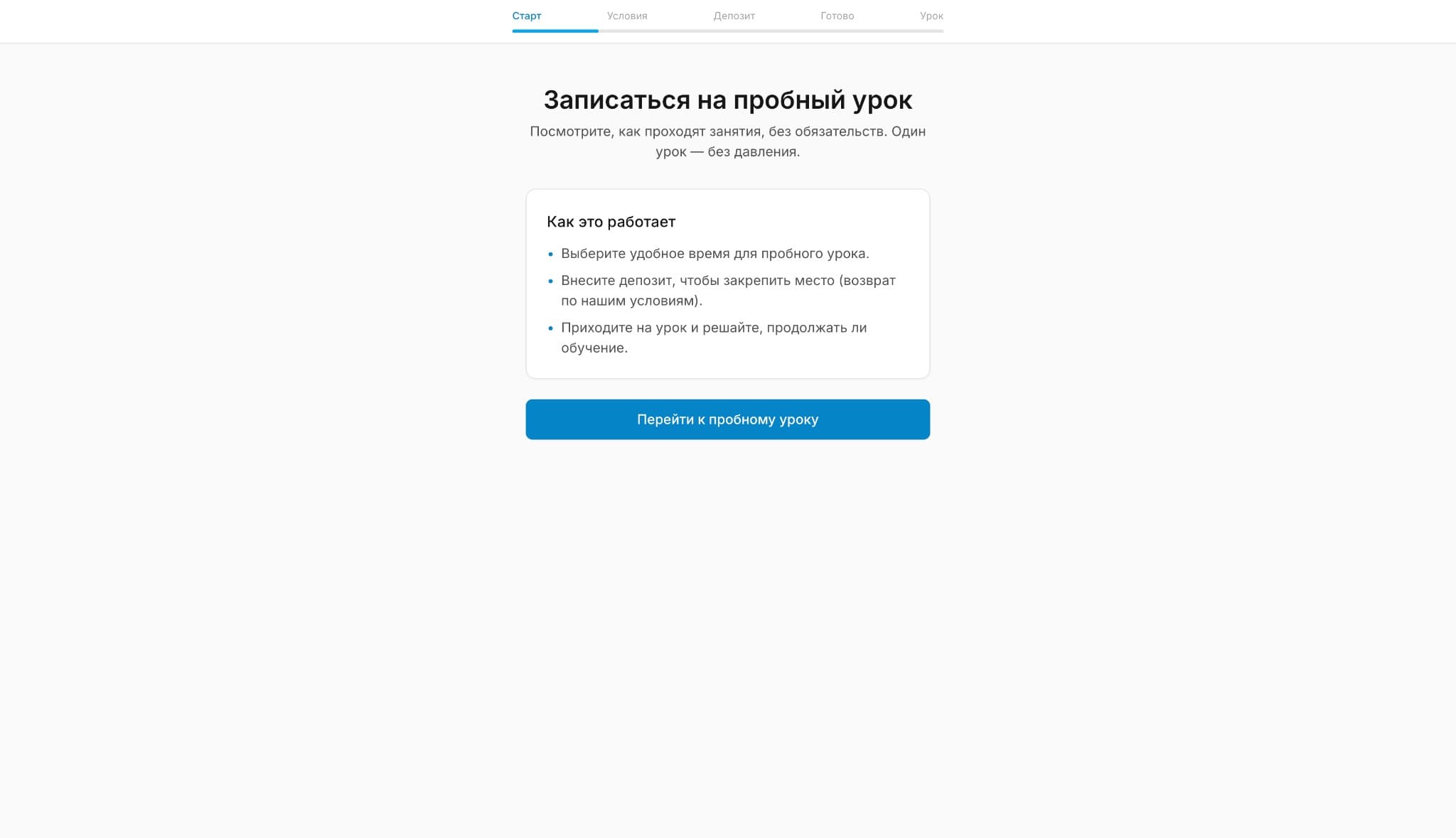
Step-by-step walkthrough of the product interface
Step 1 — Start: trial lesson booking with clear how-it-works instructions
Step 2 — Terms: deposit conditions with summary, full text, and explicit consent checkbox
Step 3 — Deposit: payment summary with amount (1000 KGS) and purpose clearly stated
Step 4 — Confirmation: deposit received with receipt details and next-step CTAs
Step 5 — Complete: all done with next steps checklist and lesson link placeholder
Documents and deliverables from the project
Deposit flow spec
4 steps
Legal terms template
Consumer protection
6-phase checklist before release
No-show rate dropped from 32% to 8%. Chargebacks reduced by 90%. Customer complaints about the process: zero. Booking completion rate improved 15%.
Each step designed with legal team. Terms are clear, not buried. Checkboxes are explicit, not pre-checked. Passes consumer protection review.
Standard card payments allow chargebacks within 120 days — the client was losing 8-12% of revenue to fraudulent refund claims. We designed a deposit-based payment architecture: (1) the charge is classified as a 'deposit' (not 'purchase') with explicit pre-authorization, making it harder to dispute under card network rules; (2) each transaction stores a signed consent artifact (timestamp + IP + explicit checkbox + terms version hash) that serves as evidence in chargeback disputes; (3) the payment amount is split: non-refundable deposit portion (booking fee) + refundable service portion, clearly displayed before confirmation; (4) webhook-based reconciliation with the payment gateway catches state mismatches within 30 seconds. After deployment, chargeback rate dropped from ~10% to under 1.5%.
Users on flaky mobile connections tap 'Pay' multiple times, or the browser refreshes mid-payment. Without idempotency, this creates duplicate charges. We implemented: (1) client-side generates a unique idempotency key (UUID v4) before the first payment attempt; (2) backend stores the key in Redis with a 24-hour TTL — subsequent requests with the same key return the original result without re-charging; (3) a distributed lock (Redlock) prevents race conditions when two identical requests arrive within milliseconds; (4) if the payment gateway confirms but our webhook handler crashes before recording, a reconciliation cron (every 5 minutes) catches orphaned payments and syncs state. Zero double-charges in production across 15K+ transactions.
Have a similar project? Get an estimate or book a call.
Full product flow: registration, public offer acceptance with audit trail, PDF proof with seal/signature, admin panel. Legally compliant, mobile‑first.
Full-cycle restaurant management system: role-based access (Chef, Employee, Accountant, Owner), ingredient inventory with cost tracking, roll recipes with auto-calculated cost/margin, set composition with pricing, order management, supply/write-off logging, accounting with Excel export, analytics dashboards, and a full audit trail for every change.
Full‑cycle mobile crypto wallet for iOS: non‑custodial key management with AES‑256‑GCM encryption, 4‑digit PIN + Face ID biometric auth, 3‑step onboarding with value‑driven storytelling, multi‑asset portfolio dashboard with real‑time price feeds (BTC, ETH, LTC, XRP), built‑in exchange with interactive candlestick charts and Buy/Sell flow, spending analytics with category‑segmented donut chart, QR‑code scanner for instant P2P transfers, multi‑currency fiat settings with 6+ currencies, OAuth social login (Google, Apple ID), 4‑digit OTP email verification, and a Node.js/PostgreSQL backend with WebSocket price streaming and CoinGecko aggregation.
20 minutes — we'll discuss your task and give an honest assessment. No strings attached.