RBAC Model (4 roles)
Chef / Employee / Accountant / Owner

Case Study
Full-cycle restaurant management system: role-based access (Chef, Employee, Accountant, Owner), ingredient inventory with cost tracking, roll recipes with auto-calculated cost/margin, set composition with pricing, order management, supply/write-off logging, accounting with Excel export, analytics dashboards, and a full audit trail for every change.
4
User roles (RBAC)
6+
Managed entities
5+
Auto-calculated metrics
A sushi restaurant needed a complete operational management system: track ingredient stock and cost, manage roll recipes with automatic cost/margin calculation, compose and price meal sets, handle orders with status tracking, log supplies and write-offs, provide accounting reports with Excel export, and separate access by role (Chef manages recipes, Accountant sees finances, Owner gets analytics). Everything had to work as one integrated system with a full audit trail.
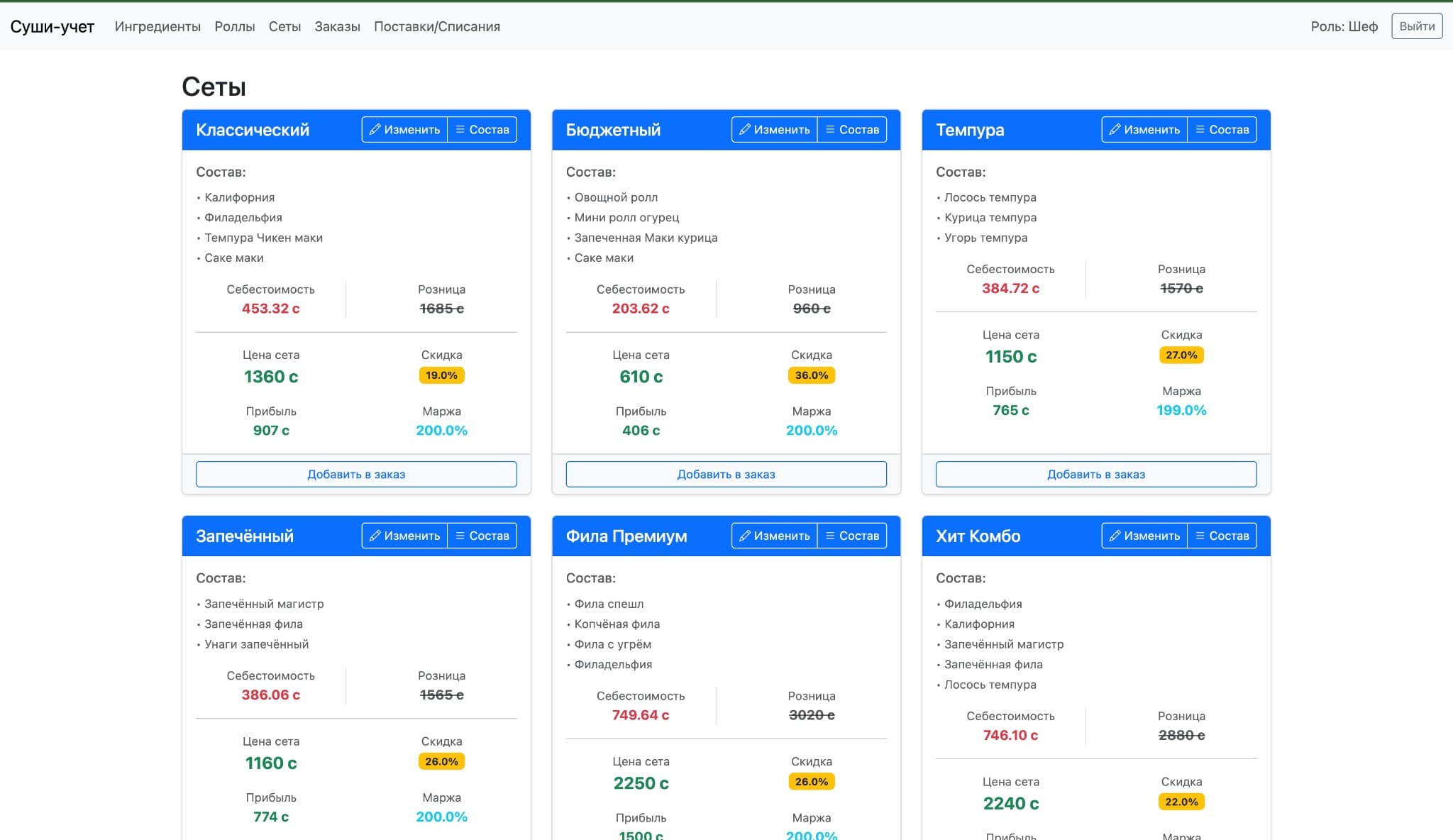
Built an integrated restaurant management system with 6 core modules: (1) Ingredient Management — CRUD with stock levels, units, cost per unit, and cross-reference to all rolls using each ingredient; (2) Roll Recipes — recipe builder with ingredient composition, auto-calculated cost, selling price management; (3) Sets — multi-roll set compositions with automatic cost, retail price, discount %, margin %, and profit calculation per set; (4) Orders — order creation for individual rolls and sets with quantity, cost, status tracking, and comments; (5) Supplies & Write-offs — ingredient supply/write-off logging with history; (6) Accounting — financial summary (revenue, cost of goods, supplies, write-offs, salary, rent, profit), ingredient stock valuation, roll pricing management, and full Excel export with ZIP backup. Plus an Analytics module with per-roll sales and profit charts, and a Change History audit trail tracking every modification.
Step-by-step walkthrough of the product interface
Login — role selection (Chef, Employee, Accountant, Owner)
Login — role dropdown with 4 business roles
Welcome dashboard — Employee role with navigation to modules
Accounting — financial summary, ingredient stock valuation, Excel export
Roll pricing — cost, selling price, inline price editing
Analytics — sales by roll and profit by roll bar charts
Change History — audit trail with action, object, old/new values, role
Ingredients — CRUD table with stock, unit, price, cross-recipe usage
Rolls — full list with selling prices and CRUD actions
Rolls — continued list with 'Add roll' form
Sets — composition cards with cost, retail, discount %, margin %, profit
Orders — order management with roll/set selection, quantity, comments
Supplies & Write-offs — ingredient supply/write-off logging with history
Documents and deliverables from the project
RBAC Model (4 roles)
Chef / Employee / Accountant / Owner
Cost Calculation Engine
Ingredients → Rolls → Sets
Accounting Module
Excel + ZIP export
Audit Trail System
Action / Object / Old→New / Role
Analytics Dashboard
Chart.js
7-phase checklist before release
Delivered a production-ready restaurant management system covering the full operational loop: ingredients → recipes → sets → orders → accounting → analytics. Four user roles with appropriate access control. Auto-calculated cost and margin for every product. Full audit trail for every change. Accounting with Excel export and ZIP backup. The system operates as a real business tool, not a demo — the owner sees profit/loss, the chef manages recipes, the accountant exports reports.
Every roll's cost is calculated from its ingredient composition and current ingredient prices. Every set's cost aggregates its rolls. When an ingredient price changes, all dependent roll and set costs recalculate automatically. Margin, discount, and profit are always up to date.
Inventory is consumed at three levels simultaneously: ingredients are used in rolls, rolls are composed into sets, and sets/rolls are sold through orders. When an ingredient supply arrives or a write-off is logged, the system must (1) update ingredient stock, (2) recalculate available production capacity for every roll using that ingredient, (3) flag sets containing those rolls if stock falls below minimum threshold, and (4) block order creation for out-of-stock items — all within a single database transaction to prevent phantom stock. We solved this with PostgreSQL triggers that cascade through the dependency graph (ingredient → roll_ingredient → roll → set_roll → set) and a materialized 'availability' view that the order creation endpoint checks atomically.
Every modification is logged with action type, object, name, details (old → new value), role, and optional comment. Critical for food businesses where recipe changes, price adjustments, and inventory movements must be traceable and accountable.
Have a similar project? Get an estimate or book a call.
Full product flow: registration, public offer acceptance with audit trail, PDF proof with seal/signature, admin panel. Legally compliant, mobile‑first.
Full‑cycle mobile crypto wallet for iOS: non‑custodial key management with AES‑256‑GCM encryption, 4‑digit PIN + Face ID biometric auth, 3‑step onboarding with value‑driven storytelling, multi‑asset portfolio dashboard with real‑time price feeds (BTC, ETH, LTC, XRP), built‑in exchange with interactive candlestick charts and Buy/Sell flow, spending analytics with category‑segmented donut chart, QR‑code scanner for instant P2P transfers, multi‑currency fiat settings with 6+ currencies, OAuth social login (Google, Apple ID), 4‑digit OTP email verification, and a Node.js/PostgreSQL backend with WebSocket price streaming and CoinGecko aggregation.
Full-cycle product development for a digital banking platform: UX research, information architecture, high-fidelity design, React frontend with real-time data, and a Node.js/PostgreSQL backend with transactional ledger, multi-provider payment processing, PDF invoice generation, scheduled transfers engine, and OAuth 2.0 + JWT authentication — from user pain points to a production-grade fintech system handling wallets, transactions, invoices, and analytics.
20 minutes — we'll discuss your task and give an honest assessment. No strings attached.