L1 Rust Node
15+ core modules

Case Study
Performance‑oriented Layer‑1 on Rust with deterministic EVM, native token economics, on‑chain perpetual orderbook, privacy layer (Bulletproofs), and a full product suite: DEX UI, Explorer, Operator Panel, Faucet, SDK.
25+
Rust core modules
4
Frontend apps shipped
90+
API endpoints
Trading latency and cost on general‑purpose L1s force perpetual DEX projects into off‑chain compromises that sacrifice verifiability. The partner needed a purpose‑built chain where the matching engine, margin logic, and settlement live at the protocol level — with full EVM compatibility, a native token with hard‑capped economics, and governance that limits parameter changes to safe bounds.
Built a single‑binary Rust node (25+ core modules) integrating consensus, validator registry, governance, slashing, fee market, EVM executor (revm, EIP‑1559/2930 + BN256 pairing precompiles EIP‑196/197 for full Ethereum precompile compatibility), native token state, DEX engine (orderbook, positions, trades, OHLC candles), privacy primitives (Bulletproofs), checkpoint sync, and hybrid storage. The node exposes 90+ HTTP endpoints, JSON‑RPC (Ethereum‑compatible), and WebSocket (EVM subscriptions + DEX realtime streams). Shipped four Next.js applications: DEX trading terminal, public block explorer with contract verification, operator UI for node management/governance/staking, and testnet faucet. Two TypeScript SDKs: @armadex/sdk (explorer/contracts) + DEX SDK (trading integration).
Step-by-step walkthrough of the product interface
DEX Trading Terminal: orderbook, price chart, buy/sell forms, market list
Markets: all trading pairs with price, volume, and action buttons
Block Explorer: batch list with hash, transactions, timestamp, status
Network Statistics: block height, TPS, total batches, success rate
Gas Tracker: gas price, average usage, network activity chart
Gas Calculator: transaction type estimation and cost formula
Verify Contract: Solidity source submission for bytecode verification
Developer Portal: Remix IDE, Faucet, RPC, Chain ID, deployment docs
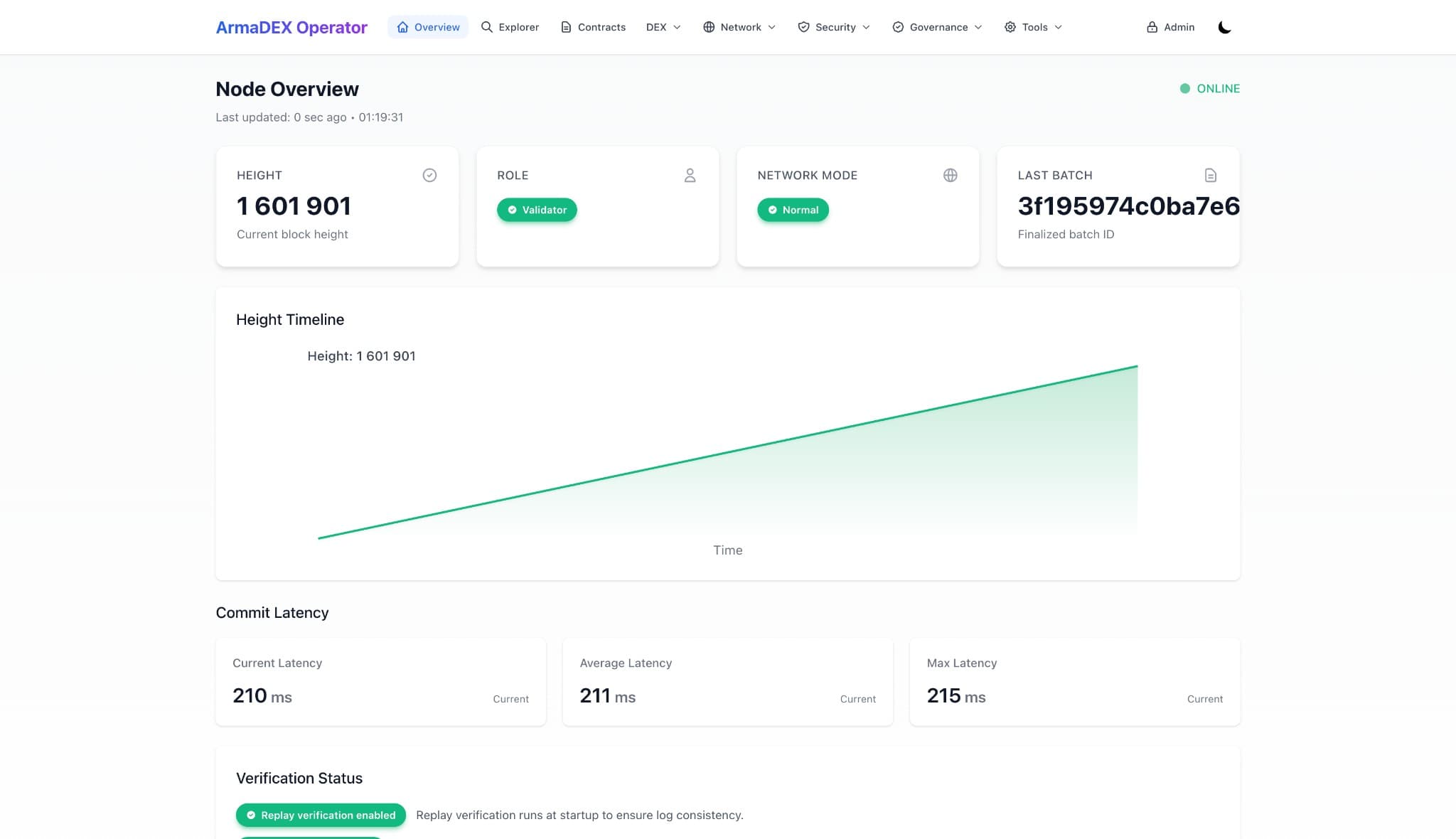
Operator Panel: node overview, block height, role, latency, verification
Operator DEX: price chart, asks/bids, last price, spread, depth
Network Overview: chain params, activity metrics, health status
Governance: create proposals, validator management, voting
Staking: validators with stake, delegation, voting power
Fraud Proof: batch verification, valid/fraudulent counts
Sync Status: progress, current height, latest checkpoint
Rolling Updates: version management, admin auth
EVM Registrations: address‑to‑trader mapping, balances
Register Validator: ID, public key, stake, signature
Faucet: request test tokens, MetaMask integration
Explorer: recent activity, network info, stats
Peer Network: connected peers discovery and monitoring
Documents and deliverables from the project
L1 Rust Node
15+ core modules
DEX Engine
Orderbook + Bulletproofs
4 Frontend Apps
DEX UI, Explorer, Operator, Faucet
TypeScript SDK
HTTP API + DEX integration
8-phase checklist before release
Testnet Alpha deployed and running: 7 active validators, 1.6M+ finalized batches (as of testnet alpha), 99%+ success rate. Full product suite operational across 90+ API endpoints: DEX terminal with realtime orderbook, block explorer with contract verification and gas tracker, operator panel with governance/staking/fraud proof controls, working faucet. Batches processed every ~2 seconds with sub‑250ms commit latency. 62 integration test suites, 77 automation scripts, 28 documentation files. Architecture, test coverage, and operational tooling at production‑grade level.
EVM execution must be fully deterministic for batch replay and fraud proofs. We run revm with EIP‑1559/2930 support, BN256 pairing precompiles (EIP‑196/197) for full Ethereum precompile compatibility, and expose the native token via a custom precompile at address 0x0a (balanceOf, transfer, totalSupply) — no ERC‑20 wrapper duplication. Every state transition is reproducible across nodes.
Orderbook, matching, positions, margin calculations, and trade settlement live inside the node binary, finalized by the same consensus as regular transactions. WebSocket streams deliver realtime updates to the UI. Shielded orders use Bulletproofs for cryptographic range proofs.
Protocol parameters can be changed through on‑chain proposals, but only within pre‑defined bounds hard‑coded into the node. Prevents governance attacks while preserving flexibility. Quorum 33%, regular >50%, critical >67%. Slashing is irreversible — governance cannot rollback penalties.
DEX Trading UI with realtime charts, orderbook depth, and wallet connection. ArmaScan explorer with contract verification via solc, gas tracker with cost calculator, and data export. Operator Panel for node monitoring, governance, staking, fraud proof, sync, and rolling updates. Faucet with MetaMask auto‑fill and rate limiting.
Have a similar project? Get an estimate or book a call.
Full-stack Web3 loyalty platform for a car rental business: utility token, NFT membership tiers (Bronze/Silver/Gold/Platinum), voucher system, staking with transparent reward logic, admin panel, and conversion-oriented landing pages.
End-to-end digital investment platform and tokenization infrastructure built at the peak of Dubai's crypto-hub momentum: onboarding, KYC/verification fully aligned with VARA's codified Virtual Assets Regulations (February 2023), Private Sale module with on‑chain token allocation, investor dashboard, admin panel with full audit trail, and Solidity 0.8 smart contracts on Polygon PoS — compliance-first architecture for a Dubai-based investment company capitalizing on the 2023 RWA tokenization wave.
MetaMask, Rabby, signing flows, JSON-RPC correctness. One broken edge breaks the product.
20 minutes — we'll discuss your task and give an honest assessment. No strings attached.